This is, without a doubt, one of the most gentle and the most powerful talks I have heard in recent times. I intend to keep coming back to it every once a while. May I urge you to take an hour off, switch all distractions, and listen to this lovely lady tell her beautiful stories? By the time she's done, you'll wish you'd heard this talk before.
Creativity: Discipline or Insanity?
Often times, I have wondered if creativity is a function of discipline or insanity. My personal experience is a conflicted one.
On the one hand, there are times when I think it a function of discipline. For instance, when I have managed to a good night's sleep, spent time in the mornings with myself thinking of what ought to be done and accomplished, gone on a long walk or run, taken downtime at scheduled intervals, end of the day, I find myself both productive and creative.
This is borne out by various research papers I stumble upon often times. Like this one for instance on the daily routines of creative geniuses.
"Juan Ponce de León spent his life searching for the fountain of youth. I have spent mine searching for the ideal daily routine. But as years of color-coded paper calendars have given way to cloud-based scheduling apps, routine has continued to elude me; each day is a new day, as unpredictable as a ride on a rodeo bull and over seemingly as quickly.
Naturally, I was fascinated by the recent book, Daily Rituals: How Artists Work. Author Mason Curry examines the schedules of 161 painters, writers, and composers, as well as philosophers, scientists, and other exceptional thinkers.
As I read, I became convinced that for these geniuses, a routine was more than a luxury — it was essential to their work. As Currey puts it, “A solid routine fosters a well-worn groove for one’s mental energies and helps stave off the tyranny of moods.” And although the book itself is a delightful hodgepodge of trivia, not a how-to manual, I began to notice several common elements in the lives of the healthier geniuses (the ones who relied more on discipline than on, say, booze and Benzedrine) that allowed them to pursue the luxury of a productivity-enhancing routine."
Then, on the other hand, there is a school of thought that argues creativity (or genius if you will) is linked to insanity of a certain kind. The most recent paper I came across was pointed out to me by my friend Peter Griffin. It appeared on The Atlantic with a provocative headline Secrets of the Creative Genius.
Kurt Vonnegut
As a psychiatrist and neuroscientist who studies creativity, I’ve had the pleasure of working with many gifted and high-profile subjects over the years, but Kurt Vonnegut—dear, funny, eccentric, lovable, tormented Kurt Vonnegut—will always be one of my favorites. Kurt was a faculty member at the Iowa Writers’ Workshop in the 1960s, and participated in the first big study I did as a member of the university’s psychiatry department. I was examining the anecdotal link between creativity and mental illness, and Kurt was an excellent case study.
He was intermittently depressed, but that was only the beginning. His mother had suffered from depression and committed suicide on Mother’s Day, when Kurt was 21 and home on military leave during World War II. His son, Mark, was originally diagnosed with schizophrenia but may actually have bipolar disorder. (Mark, who is a practicing physician, recounts his experiences in two books, The Eden Express and Just Like Someone Without Mental Illness Only More So, in which he reveals that many family members struggled with psychiatric problems. “My mother, my cousins, and my sisters weren’t doing so great,” he writes. “We had eating disorders, co-dependency, outstanding warrants, drug and alcohol problems, dating and employment problems, and other ‘issues.’ ”)
While mental illness clearly runs in the Vonnegut family, so, I found, does creativity. Kurt’s father was a gifted architect, and his older brother Bernard was a talented physical chemist and inventor who possessed 28 patents. Mark is a writer, and both of Kurt’s daughters are visual artists. Kurt’s work, of course, needs no introduction. For many of my subjects from that first study—all writers associated with the Iowa Writers’ Workshop—mental illness and creativity went hand in hand. This link is not surprising.
The archetype of the mad genius dates back to at least classical times, when Aristotle noted, “Those who have been eminent in philosophy, politics, poetry, and the arts have all had tendencies toward melancholia.” This pattern is a recurring theme in Shakespeare’s plays, such as when Theseus, in A Midsummer Night’s Dream, observes, “The lunatic, the lover, and the poet / Are of imagination all compact.” John Dryden made a similar point in a heroic couplet: “Great wits are sure to madness near allied, / And thin partitions do their bounds divide.”
I quite liked one of the more compelling arguments in this piece. Having too many ideas can be dangerous. Part of what comes with seeing connections no one else sees is that not all of these connections actually exist.
Often times I find myself veering towards this school while at work on something that catches my attention. Nothing else matters then, except the task on hand. People around think of me as a dervish in full swirl. It is a theme around which AR Rahman and I had an interesting conversation. Is he insane? Most certainly not. Does he have quirks? Yes.
What am I to make of this? I don't have a clue.
I want change
An HBR Blog Post dating back to 2009 by Umair Haque found resonance with me. I'm reproducing it in toto below.
Dear Old People Who Run the World,
My generation would like to break up with you.
Everyday, I see a widening gap in how you and we understand the world — and what we want from it. I think we have irreconcilable differences.
You wanted big, fat, lazy “business.” We want small, responsive, micro-scalecommerce.
You turned politics into a dirty word. We want authentic, deep democracy —everywhere.
You wanted financial fundamentalism. We want an economics that makes sense for people — not just banks.
You wanted shareholder value — built by tough-guy CEOs. We want real value, built by people with character, dignity, and courage.
You wanted an invisible hand — it became a digital hand. Today’s markets are those where the majority of trades are done literally robotically. We want a visible handshake: to trust and to be trusted.
You wanted growth — faster. We want to slow down — so we can become better.
You didn’t care which communities were capsized, or which lives were sunk. We want a rising tide that lifts all boats.
You wanted to biggie size life: McMansions, Hummers, and McFood. We want to humanize life.
You wanted exurbs, sprawl, and gated anti-communities. We want a society built on authentic community.
You wanted more money, credit and leverage — to consume ravenously. We want to be great at doing stuff that matters.
You sacrificed the meaningful for the material: you sold out the very things that made us great for trivial gewgaws, trinkets, and gadgets. We’re not for sale: we’re learning to once again do what is meaningful.
There’s a tectonic shift rocking the social, political, and economic landscape. The last two points above are what express it most concisely. I hate labels, but I’m going to employ a flawed, imperfect one: Generation “M.”
What do the “M”s in Generation M stand for? The first is for a movement. It’s a little bit about age — but mostly about a growing number of people who are acting very differently. They are doing meaningful stuff that matters the most. Those are the second, third, and fourth “M”s.
Gen M is about passion, responsibility, authenticity, and challenging yesterday’s way of everything. Everywhere I look, I see an explosion of Gen M businesses, NGOs, open-source communities, local initiatives, government. Who’s Gen M? Obama, kind of. Larry and Sergey. The Threadless, Etsy, andFlickr guys. Ev, Biz and the Twitter crew. Tehran 2.0. The folks at Kiva, Talking Points Memo, and FindtheFarmer. Shigeru Miyamoto, Steve Jobs, Muhammad Yunus, and Jeff Sachs are like the grandpas of Gen M. There are tons where these innovators came from.
Gen M isn’t just kind of awesome — it’s vitally necessary. If you think the “M”s sound idealistic, think again.
The great crisis isn’t going away, changing, or “morphing.” It’s the same old crisis — and it’s growing.
You’ve failed to recognize it for what it really is. It is, as I’ve repeatedly pointed out, in our institutions: the rules by which our economy is organized.
But they’re your institutions, not ours. You made them — and they’re broken. Here’s what I mean:
“… For example, the auto industry has cut back production so far that inventories have begun to shrink — even in the face of historically weak demand for motor vehicles. As the economy stabilizes, just slowing the pace of this inventory shrinkage will boost gross domestic product, or GDP, which is the nation’s total output of goods and services.”
Clearing the backlog of SUVs built on 30-year-old technology is going to pump up GDP? So what? There couldn’t be a clearer example of why GDP is a totally flawed concept, an obsolete institution. We don’t need more land yachts clogging our roads: we need a 21st Century auto industry.
I was (kind of) kidding about seceding before. Here’s what it looks like to me: every generation has a challenge, and this, I think, is ours: to foot the bill for yesterday’s profligacy — and to create, instead, an authentically, sustainably shared prosperity.
Anyone — young or old — can answer it. Generation M is more about what you do and who you are than when you were born. So the question is this: do you still belong to the 20th century – or the 21st?
Love,
Umair and the Edge Economy Community
Roger Ebert on remaking his voice
So you think you got a problem? Tell you what. Watch this. And get on with life dammit!
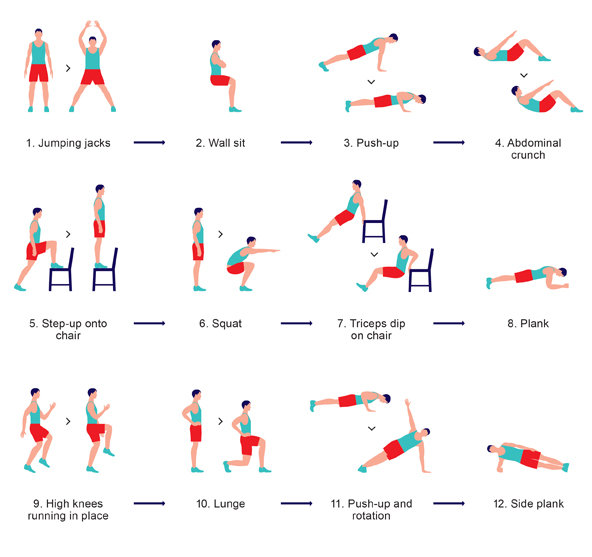
Illustration reproduced from www.nytimes.com
Does this workout work?
Came across this interesting blogpost on the New York Times website that claims this high intensity workout, illustrated above, and meant to be completed in seven minutes is all you need. Click here for the full post.
Naham Janami....
Perhaps the most powerful song I've heard. It's the kind of song that plays and plays and plays at the back of your mind and refuses to leave you. For those inclined to watch the movie, Ship of Thesus, a legal, HD version of it is available for viewing here