• About
  • Body Hacks
  • Blog
  • my book
  • Connect
  • Menu

charles assisi

  • About
  • Body Hacks
  • Blog
  • my book
  • Connect
text-paper-wood-typography.jpg

Our monotonous lives

June 18, 2020 in Hindustan Times, Living

Because we’re fed on clichés such as ‘Strive to make every day a masterpiece’, it is inevitable that most of us feel despondent at times like these. Despite starting out with the best intentions, our days become monotonous because we’re locked down. It is only human to think about what can be done to escape that monotony.

But examine history and you see that monotony appears to be inherent and essential to the human condition. In fact, humanity has progressed on the backs of those who embraced monotony and imagined it as a series of elaborate rituals.

By way of example, Isaac Newton was most prolific when everyone was quarantined at home during the Great Plague of 1665. He used the time alone to think about differential and integral calculus, formulated a theory of universal gravitation, and explored the nature of optics by drilling a hole in his door and studying the beam of light it let in. How much more beautiful can the human mind get?

In a more recent context, consider something as monotonous as the washing of hands. It has now been imposed on us. What can possibly be exciting about something as monotonous as that?

Well, when looked at through the eyes of award-winning writer Atul Gawande, if not done right, it can take those whom he examines closer to death in his day job as a surgeon. In his book, Better: A Surgeon’s Notes On Performance, he points out, all research and his experience articulate strict protocols physicians must adhere to while performing what sounds like a perfunctory act.

Turns out, a hand wash with plain soap can reduce bacterial count, but this isn’t good enough. To wash well, an antibacterial soap is needed. But to wash hands the right way, all external objects such as a watch or ring must first be removed. Following which the hands must be held under warm water for a few moments. Soap must then be dispensed and lathered on the hands and lower one-third of the arms for 15 to 30 seconds. The hands must then be rinsed for a full 30 seconds in warm water and dried with a disposable towel. Only then is the act of washing hands considered complete.

Now, this begins to sound like an elaborate ritual. Failure to engage in this ritual can spread infections and cause death. When this ritual is examined closely, there is purpose to it. Done well over the long term, it can make the difference between life and death, many times over.

All evidence has it that washing hands well is currently our primary weapon against the coronavirus. What does that imply? That we should accept that life will sometimes be monotonous. But we can me make that monotony worthwhile by examining the little details inherent in it, and turning practice to perfection, deliberately.

This article was first published in in the Sunday edition of Hindustan Times

Tags: LifeHacks, Hindustan Times
Comment
Image by Zoutedrop under Creative Commons

Image by Zoutedrop under Creative Commons

Dear younger self...

May 15, 2020 in Living, Philosophy

Dear 16-year old self,

At 47, I have no pretensions of being a wise man. Because as Hunter S. Thompson, that godfather of gonzo journalism, whom I worship, wrote so eloquently: “To give advice to a man who asks what to do with his life implies something very close to egomania. To presume to point a man to the right and ultimate goal—to point with a trembling finger in the right direction—is something only a fool would take upon himself."

That said, I couldn’t help but think of what my friend Dr. Rajat Chauhan keeps articulating in so many different ways. The other day, for instance, he tweeted, “Failure is inevitable. It’s about having the persistence to beat the pulp out of failure."

It got my attention and I asked him to make a signed poster out of it that I may frame and keep in my room.

That is why I know what you feel right now. With the kind of scores you have managed in Class XII, you will never make it to medical school. I know you want to go there real bad. So, it’s okay to cry. And feel those tears running down your face. I want you to hurt. Not just hurt, but hurt real bad. I want you to embrace failure, make it your best friend, and learn from it.

That said, there are three instances I want you to particularly fail in as you grow up—love, friendships and work.

I understand I may sound ridiculous to you right now. But let’s face it.

That object of your affection whose hand you hold right now exists only in fairy tales. Even as she consoles you and tells you the both of you can carve a life out in some pretty corner of the world, don’t forget you are only 16, much like she is. Don’t hate me for saying this. What you are experiencing right now is puppy love. I am not suggesting here you ought not to experience it. Everybody ought to. But it won’t last. You know why?

Because right now you are in love with the idea of love. I wish I could explain that as eloquently as John Steinbeck, one of my favourite writers, did in a letter to his son:  “There are several kinds of love. One is a selfish, mean, grasping, egoistical thing, which uses love for self-importance. This is the ugly and crippling kind. The other is an outpouring of everything good in you—of kindness and consideration and respect—not only the social respect of manners but the greater respect which is recognition of another person as unique and valuable. The first kind can make you sick and small and weak but the second can release in you strength, and courage and goodness and even wisdom you didn’t know you had.”

It is a rare set of individuals who find the second kind of love when they are as young as you are.

So, I want you to go out there and get your heart broken a few times, until you find that somebody who can extract goodness out of you—of your own free will. Trust me, the road to finding this kind of love is a painful one. It is inevitable the one whose hand you are clinging to now will move on as will you. It is also inevitable you will find true love. But brace yourself for heartbreak on the way to it.

Because, as David Whyte writes in Consolations, “Heartbreak is how we mature; yet we use the word heartbreak as if it only occurs when things have gone wrong: an unrequited love, a shattered dream… But heartbreak may be the very essence of being human, of being on the journey from here to there, and of coming to care deeply for what we find along the way…. There is almost no path a human being can follow that does not lead to heartbreak.”

And when you do find love, respect it and cling to it.

Much the same can be said of friendships. It is a myth that deep and meaningful relationships are forged in your formative years. The fact is, over time, you outgrow them. The friends you have in your teens are very different from the ones you have in your 20s, 30s and 40s. As you search for meaning, with every decade, you will morph into a different animal and will seek bonds that fit the animal you are then.

By way of example, I can think of this gentleman I met the other day, now in his 60s. There was nostalgia and tears in his eyes as he reminisced about his friend from 40 years ago who sought him out for counsel every other day. Time changed things between them. His friend has gone on to larger things and doesn’t need his counsel any more. His attention has turned instead to others with a larger perspective whom he looks upon with awe and seeks out.

I understand the tears and the nostalgia. But they are rooted in the past. You swear now by friends who roar to Metallica and Guns N’ Roses. But trust me . When you discover the pleasures of Paul Simon, the serenity of Beethoven and the comfort good single malts offers over Old Monk rum, you will wonder how you air-guitared at alcohol-soaked, pot-filled concerts all night long.

And while I am at that, another word of advice from a now world-weary man—never, never touch a cigarette a friend offers. It may seem cool and you may look like a wimp if you decline. But the real wimps are the ones who smoke. I know. I’m still paying the price for having indulged in it.

When it comes to work, there is this tussle you will be engaged in. Allow me to assure you once again, like most people, you are destined to fail if you don’t give yourself the room to think through and introspect. Who do you want to be? What is your calling? What are your priorities?

But the exigencies, such as money, that life imposes will push you towards a path often trod by most people. Like I did when looking for a job. Entrepreneurship wasn’t my calling. It was an accident. That it turned out to be a lucky accident and eventually my calling is an altogether different matter. It is entirely possible, though, that you may not get as lucky. That is why I want you to dwell on this passage from The Road to Character by David Brooks.

“I’ve been thinking about the difference between the résumé virtues and the eulogy virtues. The résumé virtues are the ones you list on your résumé, the skills that you bring to the job market and that contribute to external success. The eulogy virtues are deeper. They’re the virtues that get talked about at your funeral, the ones that exist at the core of your being—whether you are kind, brave, honest or faithful; what kind of relationships you formed.

“Most of us would say that the eulogy virtues are more important than the résumé virtues, but I confess that for long stretches of my life I’ve spent more time thinking about the latter than the former. Our education system is certainly oriented around the résumé virtues more than the eulogy ones. Public conversation is, too—the self-help tips in magazines, the non-fiction bestsellers. Most of us have clearer strategies for how to achieve career success than we do for how to develop a profound character."

My final submission to you is, the earlier you can think of a eulogy to yourself, distanced from the exigencies of life I spoke of earlier, the better off you will be for it.

Much love,

Your 47-year-old future self

Tags: LifeHacks, Living, Philosophy, Life, Life Hacks, Livemint, Failure
2 Comments
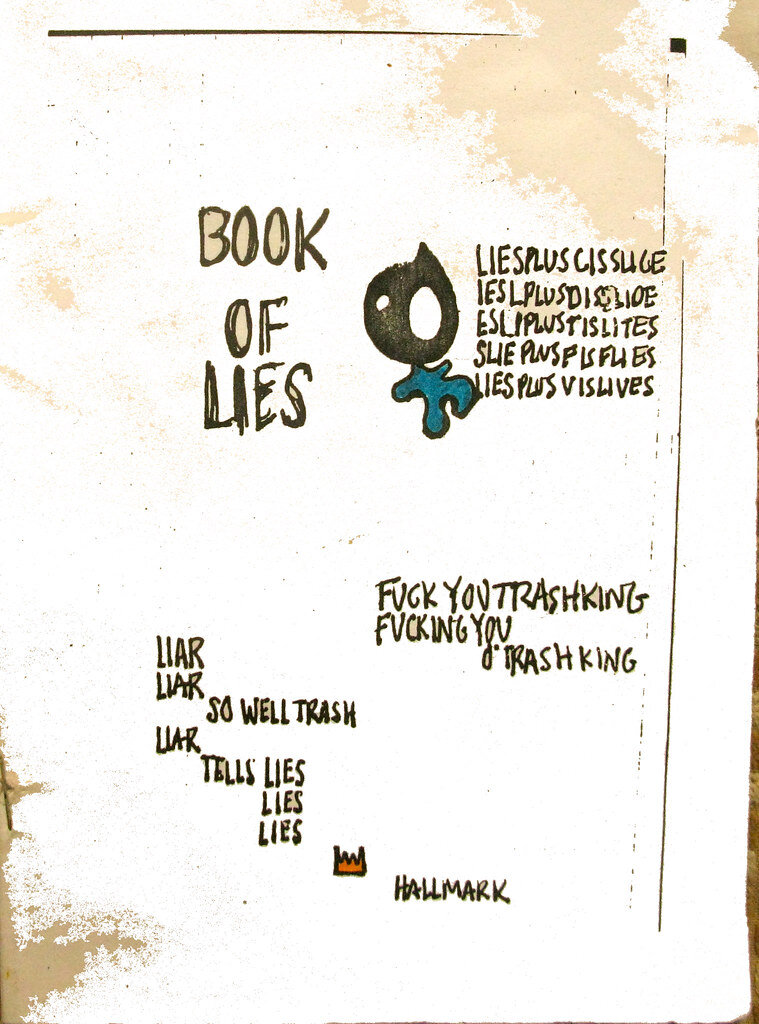
book of lies © 1992, scott richard (cover) Image Under Creative Commons

book of lies © 1992, scott richard (cover) Image Under Creative Commons

The ethics of lying

May 12, 2020 in Philosophy, Living

A little before I sat down to write this piece, I saw a headline that screamed: “I never lie”. It featured someone from the advertising business. I couldn’t help but snigger. What’s wrong with a lie, I wondered.

Indeed. It is a question that has resided in our collective human conscience forever. So much so that it resides as one among the central themes of that philosophical tour de force the Mahabharata is—an epic narrative of the Kurukshetra war and the fates of its protagonists that comprise two warring clans, the Kauravas and the Pandavas.

In the epic, there is this part where one of the greatest warriors of all time, Drona, is on a rampage through the Pandava ranks. Related to both sides as an uncle, for various reasons, he chose to align himself with the Kauravas in this battle. If he isn’t stopped, the Pandavas fear it is only a matter of time before their army is in shreds. The oldest of the five Pandava brothers, Yudhisthira, then turns to their spiritual and philosophical mentor Krishna for counsel.

Krishna, the eighth avatar of Vishnu, the supreme god, tells Yudhisthira this is a war that must be won. And that if a lie ought to be told to win it, then the lie must be told. In this instance, Krishna knows Drona’s only weakness is his son Ashwathama. So, he asks Yudhisthira to spread the word that Ashwathama is dead. But Yudhisthira has a problem with that. His morality and reputation do not permit him to lie. He despises it as dishonest.

But even as Yudhisthira is thinking through Krishna’s proposition and its implications, Bhima, one of the Pandava brothers, kills an elephant named Ashwathama and screams: “Ashwathama is dead”. Word reaches Drona. The man thinks it is his son Bhima is talking of. Stunned, he refuses to believe the news until he hears it from Yudhisthira and summons him.

Krishna’s words still ringing in his ears, Yudhisthira goes over to his uncle’s camp.

“Is it true,” Drona asks him, “that Ashwathama is dead?”

“Yes,” Yudhisthira says. And then trails off inaudibly, “Ashwathama the elephant.”

Technically, Yudhisthira did not lie. But Drona doesn’t catch the words, lays down his weapons and bows his head in grief. In that very instant, on Krishna’s instructions, Dhrishtadyumna, Yudhisthira’s brother-in-law, chops his head off.

In Vedic society, this is the worst possible crime. The Pandavas killed an unarmed Brahmin on the back of subterfuge who in their younger years was a teacher to them as well. But it had to be done for the sake of “dharma”, argues Krishna.

When looked at from Krishna’s perspective, it makes sense. All of the brothers are killing each other, too many people are dying and the war has to end in everybody’s interest. To that extent, morality demands that Yudhisthira lie. The end, in this case, argues Krishna, justifies the means. Psychology has it that Krishna makes this call without compunction because he is emotionally more evolved.

This argument though has always been under scrutiny with much being written and debated around it. The founding fathers of the Christian church like St Augustine make it abundantly clear that a lie is a lie, no matter what the intent is. Western philosophical thought led Immanuel Kant and closer home Mahatma Gandhi find their moorings in this school of thought. They leave no room for a lie in any shade. And that is what we are taught to live by.

As Michael Sandel, who teaches philosophy at Harvard University, points out, Kant believed that telling a lie, even a white lie, is a violation of one’s own dignity. But do exceptions to the rule exist? When is ambiguity possible? For instance, if your friend were hiding inside your home, and a person intent on killing your friend came to your door and asked you where he was, would it be wrong to tell a lie? If so, would it be moral to try to mislead the murderer without actually lying?

This question has implications in modern-day business as well. In a paper published last year titled Are Liars Ethical, Maurice Schweitzer, a professor of operations and information management at Wharton University, and co-author Emma Levine veer philosophically to Krishna’s side.

The video of a conversation with them can be viewed here. The sum and substance of their argument is this: “We look at deception that sometimes can be helpful to other people. We typically think about deception as selfish deception: I lie to gain some advantage at the expense of somebody else. And we typically think of honesty as something that might be costly to me, but helpful to others.”

“In our research, we actually disentangle those two things. We think about deception that can help other people, and honesty that might be helpful to myself and maybe costly to somebody else. When we separate honesty and deception from pro-social and pro-self-interests, we find that people actually don’t care that much about deception. We find that the aversion to lying, when people say ‘Don’t lie to me’, what they really mean is, ‘Don’t be really selfish’.”

To that extent, they argue that in the kind of world we live in, it is time to revisit the dictum: Honesty is the best policy. Instead, we ought to understand when we should lie. “When does honesty actually harm trust and seem immoral? And when can deception actually breed trust be seen as moral?”

The reason this is pertinent is because in business, managers have to balance between benevolence and honesty, where benevolence is about being kind and providing supportive feedback. Honesty, on the other hand, can be critical and harsh. Not everybody is built to handle honesty. To that extent, it makes sense to err on the side of benevolence in the longer-term interests of building trust and relationships.

Schweitzer and Levine studied the tension between honesty and benevolence under controlled conditions that it may be applied in business. Their findings make for a compelling read.

“There are a lot of domains in which individuals face this conflict between honesty and benevolence very, very intensely. One example is in healthcare. Doctors frequently have to deliver very negative news to patients. And actually, prior research has found that oftentimes, doctors do lie. They inflate the positivity of these prognoses. We seem to think this is bad, and I think doctors feel a lot of tension and conflict around how to handle the situation.

“But our research suggests that perhaps doctors, and maybe teachers and parents, should be explicitly acknowledging this tension and this trade-off, and thinking about and talking about how to navigate it. When might benevolence and kindness, and maybe a little dishonesty, be right or be appreciated, and how could that enhance the delivery of medicine?

“Another case where we manage this balance between being completely honest and managing being benevolent is when we interact with children. This is true as parents, and it’s also true as educators. So, teachers will need to give feedback to students. And they have to balance this tension between being completely candid, and being benevolent and kind—demonstrating kindness and concern for the child.

“As parents, we frequently tell our kids, ‘Never lie’. But that’s not at all what we mean. For example, before we go over to grandma’s house, we might tell them, say, ‘Remember, thank grandma for that sweater, and tell her how much you like it, even though we both know you never wear it’.”

This is the kind of ambiguity and tension Krishna nailed with precision almost 3,000 years BCE when the Mahabharata was written.

But who’s to tell that to the man in advertising who claims he never lies?

Tags: Mint on Sunday, Founding Fuel, Philosophy
Comment
Image: Used under Creative Common 4.0

Image: Used under Creative Common 4.0

Five Laws of Human Stupidity

February 27, 2020

It is entirely coincidental that while listening in to my mother and sisters argue passionately whether or not it was right on part of a leading Malayalam actor to dump his wife of many years and marry a much younger creature, I was on the phone with my friend Dr Anurag Misra, a psychiatrist based out of out of New Delhi.

Exasperated, I told him, it wasn’t just them — but all of the people in Kerala seemed to be besotted by his shenanigans. Why do people spend as much time discussing inane issues, I asked. He laughed and pointed me to a paper that sounded intriguing: The Basic Laws of Human Stupidity by Carlo M. Cipolla. 

Their fascination, he said, proves Cipoll’s First Basic Law: Human stupidity asserts without ambiguity that always and inevitably everyone underestimates the number of stupid individuals in circulation. 

What else can explain how my family — and for that matter, the most literate state in the country — had come to a standstill because of a marriage? 

Incidentally, Cipolla taught at the University of California in Berkeley and died in 2000, aged 78. A scholar of much repute, he is most known for this treatise of his. It was a national bestseller in his native Italy, was immortalized in a play in France, and translated into English as well. 

The paper got my attention right away. I read all of it and laughed through it. I was wondering what Anurag’s larger point was. How could I possibly use it to interpret what I see around me? 

While the paper is indeed humorous, it was also intended to be a deeply philosophical one. And the First Basic Law had just been proven a night after we spoke. All said and done, I spent some time on it and wondered if there is indeed some merit in what the paper articulates. Turns out, there is. 

The Second Basic Law: The probability that a certain person be stupid is independent of any other characteristic of that person. 

I’ll tread with caution here because by way of evidence I cannot divulge names. But this much I can assert in my defence. Perhaps, 25-odd years down the line, if I have the mental muscle left in me to write a memoir on the back of the many hundreds of interviews I have conducted over my career with business leaders, I can think up quite a few icons who would tumble. 

Two come to mind right away. What binds both is that even though they are part of different industries, they transformed how India lives. 

The first name attracts fanatical devotion. The entity he took over and the jobs his entity offers are prized. If the entity’s brand name is stamped on anything, it is by any yardstick considered the gold standard for quality, ethics and transparency. He was always dignified and handed the baton over to a man of impeccable pedigree and intended to spend his retirement in introspection and search for a higher truth. 

But as things turn out, he is also stupid. Because over the years, when he was at the helm, for reasons best known to him, he was surrounded by a “coterie". How ironic. Because he had started his career out by disbanding a firmly entrenched “coterie". What ought to be have been his golden years are now turning into a tumult. Egged on no doubt by a coterie who was at a loss without him around. What else explains his emergence from what ought to have been his sunset years? 

The second name is one that evokes images of the patriarch. His voice has often been the final word in many high-profile discussions that have needed an intermediary of impeccable integrity. The institution he created is the subject of much awe. If you were to ask me to read a eulogy to him in a single line, it would be this: “He was the Bhishma Pita Maha of all things you can ascribe to modernity in Indian business." 

But the institution closest to his heart, and one he passed to the one who met with approval from both him and the board, is now cracking. The leadership is in exit mode. Private conversations with some reveal details of an ill thought out succession plan. I have it from them that when faced with a crisis, he would often freeze, and it was left to his lieutenants to take over. 

What he couldn’t see, though, was that they had an agenda to push. Because when it was time for him to pass on the mantle, they fought a fierce battle behind the scenes. It was a dirty one, and he was completely oblivious to it. 

Whether he was willfully blind is not known. Whatever be the case, the successor turned out to be among the most manipulative. The others left and have since moved on to head entities now sniping at the top dog’s heels. How else do you describe this, but stupidity on his part? This, in spite of all of his brilliance and foresight. 

The Third (and golden) Basic Law: A stupid person is a person who causes losses to another person or to a group of persons while himself deriving no gain and even possibly incurring losses. 

This may sound preposterous. Before getting into some examples of how it plays out in life, let us carefully go over what Cipolla presents in his paper. 

“When confronted for the first time with the Third Basic Law, rational people instinctively react with feelings of scepticism and incredulity. The fact is that reasonable people have difficulty in conceiving and understanding unreasonable behaviour. But let us abandon the lofty plane of theory and let us look pragmatically at our daily life." 

“We all recollect occasions in which a fellow took an action which resulted in his gain and our loss: we had to deal with a bandit. We also recollect cases in which a fellow took an action which resulted in his loss and our gain: we had to deal with a helpless person. We can recollect cases in which a fellow took an action by which both parties gained: he was intelligent. Such cases do indeed occur."

“But upon thoughtful reflection you must admit that these are not the events which punctuate most frequently our daily life. Our daily life is mostly, made of cases in which we lose money and/or time and/or energy and/or appetite, cheerfulness and good health because of the improbable action of some preposterous creature who has nothing to gain and indeed gains nothing from causing us embarrassment, difficulties or harm. Nobody knows, understands or can possibly explain why that preposterous creature does what he does. In fact, there is no explanation—or better there is only one explanation: the person in question is stupid." 

And Cipolla laughs it away. If you think about it for a while, it is not something to be laughed away. Because what Cipolla is eluding to is something very fundamental. And one that all of us are susceptible to. 

Imagine a situation where you are walking through the aisles of your workplace and you happen to listen in to your boss tell the people on the human resources team that your pay be raised by, say, Rs5,000. For no apparent reason. And it is not even appraisal time. Undoubtedly, you would be happy. 

Now, imagine, yourself walking down the same aisle. But this time around you hear that your pay is to be deducted by Rs5,000? What happens to you? How do you feel? 

In the first instance, the money has not come to you. In the second instance, the money has not been deducted from you. They were suggestions. What if they were pranks being played on you by somebody who had no better way to expend time? 

In any case, the individual managed to grab your attention and wear you out. How much more stupid can you get? But this is also the beginning of the theory of loss aversion. And out of it emerged a startling discovery that has been deployed to great effect by marketers to manipulate our minds to part with money. 

There are various studies that have documented around it—most notably by the neurobiologist Dean Buonomano in his book, Brain Bugs: How the Brain’s Flaws Shape Our Lives. 

In the brouhaha after demonetization, many of us went and signed up for e-wallets of all kinds. But did you consider this? All wallets are only as good as the network they operate in. 

You deposited your monies there. It earns no interest for you, unlike it would in banks or even post offices. And you can use these networks only at places that accept them. I followed the herd and deposited some money in two e-wallets. 

Many roadside vendors sport their stickers—including my chai wala. When I offered to pay him through the wallet, he said he doesn’t have it yet. I conducted an informal survey of vendors around the place I live in. Apparently, though many have the stickers they don’t have the systems in place. Some of those who do have yet to figure out how to operate it. 

Who’s stupid? The vendors for allowing the e-wallet companies to plant stickers on their stalls to attract customers? People like me who loaded wallets up to ease life because we’ve run out of cash? Or e-wallet companies trying their damndest best to grow and incurring heavy expenses on advertising and putting into place an infrastructure that can meet demand? 

As things are, I might be the stupidest of the lot, because my monies now lie with entities still scaling up and what I have on hand are IOU notes to vendors who don’t know what to do with them. 

The Fourth Basic Law: Non-stupid people always underestimate the damaging power of stupid individuals. In particular, non-stupid people constantly forget that at all times and places and under any circumstances to deal and/or associate with stupid people always turns out to be a costly mistake. 

I have nothing else to ask here other than why is it that non-stupid people engage in stupid arguments on social media and with vocal anchors on prime-time television? 

The Fifth Basic Law: A stupid person is the most dangerous type of person. 

In spite of knowing about all of these, I routinely violate it.

What it means is, there is a thin line that separates ignorance and stupidity. While the ignorant can be forgiven for not knowing better, a stupid creature understands everything in theory, but chooses to behave in totally asinine ways. That makes a stupid person a very dangerous creature.

Much like those who wield political power right now.

Comment
Image: Xoan Seoane under Creative Commons

Image: Xoan Seoane under Creative Commons

Career crisis's are inevitable. Deal with it

February 21, 2020 in Hindustan Times, Living

History is easy to understand because it is a series of events that can be examined and explained. Attempting to imagine the future is difficult because multiple possibilities exist. How far out into the future must we plan our careers then?

Eighteen months, on the outside, argues Peter Drucker, the legendary management teacher, consultant and author, in his seminal essay, Managing oneself. While this may sound incredulous, I have come to believe that he is right.

Most of my friends and acquaintances have now invested 20 or 25 years at work in the same domain, and sound unhappy. Asked what’s next, clichéd answers emerge such as, “Open a boutique café in a quiet town”. Whatever is the matter? When did imagination die? Drucker offers pointers.

Most people in the generation that preceded us engaged in hard (or physical) work. After having done that for 40-odd years, most are now content doing nothing.

But knowledge workers (people like us) have replaced them across most domains. Twenty-odd years into a job, one of two things happen.

  1. By now, we know our jobs inside out. We are actually bored by them. To feel alive, we must do something else. But we don’t know we are bored and imagine we are going through a mid-life crisis.

  2. The industry we are at work in has transformed. But we haven’t. We are redundant. But incapable of doing anything else because we haven’t ever learnt to.

In both scenarios, people like us don’t know how to deploy the remaining years of our lives. Then, there is the nature of life itself. Knowledge workers who got into the workforce have only seen the upside. But as Drucker succinctly points out, “No one can expect to live very long without experiencing a serious setback in his or her life or work… There are tragedies in one’s family life: the breakup of one’s marriage or the loss of a child… In a knowledge society, however, we expect everyone to be a success. This is clearly an impossibility. For a great many people, there is at best an absence of failure. Wherever there is success, there has to be failure.”

A report by the McKinsey Global Institute has it that by 2030 we will be at the point where, at least in theory, half of the jobs we are now paid to do can be “automated using currently demonstrated technologies”.

A caveat must be filed, though. Technology can take time to evolve and often meets with headwinds. That is why, after factoring in for some caution, the authors of the report sound confident that in at least 60% of the occupations they surveyed, one-third of the tasks humans currently manage will be capable of being automated. Simply put, 10 years from now, our workplaces will be very different.

But the boredom I pointed to earlier is already evident because the precursors to change have started to make themselves felt. Conversations with friends who work in logistics, transportation, finance, hospitality, and industries where physical labour is intense have the same narratives to share. Between artificial intelligence and automation, it is only a matter of time before they are either downgraded or made redundant. What they feel now is exasperation because they worked for over two decades to get to where they are now.

But it is incumbent upon us to proactively manage adversity. If that includes shedding all narratives about our success, prepping for new careers, and beginning all over again, so be it. 

A World Economic Forum report is an eye-opener on the kinds of jobs the future needs. These include organ part creators (those who can combine 3D printing skills with stem cell research to grow organs on demand), landfill work operators (robotic earthworms operated by humans) and mind transfer specialists (people who transfer what is in the brain to a computer), among others. 

These sound incredibly exciting. But to get on top of it, work must begin now. It takes at least 20 to 25 years to craft a new future — roughly the same time it took most exasperated professionals to get on top of their current game.

This piece was originally published in the Sunday Edition of Hindustan Times

Tags: LifeHacks, Hindustan Times
2 Comments
Image by Teo on Flickr and published under Creative Commons 2.0

Image by Teo on Flickr and published under Creative Commons 2.0

GTD Lists versus Values Lists

January 04, 2020

Any piece that screams about how to be insanely more productive or some such thing always got my attention. I have a hypothesis on why.

Now that the mid-forties have kicked in, between a paunch, career dilemmas, early signs of chronic diseases and the onset of common sense, panic has crept in.

A voice often asks: How could you possibly have been so irresponsible in your earlier decades? I guess this is what they call a midlife crisis.

One of the first things I did to course-correct was create lists of all kinds, to embrace the Getting Things Done (GTD) way of life. What, after all, is life without a plan? These lists, most literature has it, turn people into super-efficient creatures.

But after much tinkering with GTD tools and observing of how others use them, I’m convinced it isn’t worth it. This, because people are of four types. 

Type 1: Those who make lists and get things done. The ideal way to be.

Type 2: Those who create lists and get some things done. An okay way to be.

Type 3: Those who create lists and get nothing done. A sub-optimal way to be.

Type 4: Those who don’t create lists and get everything done. A super way to be.

When I examined my logs over time, I realised I rarely behave like Type 1. I swing between Types 2 and 3. On asking around, it turned out most people are the same.

Everyone makes plans with the best intentions and their calendars look packed (what a satisfying feeling that is, isn’t it?). But asked how they feel at the end of the day, most people acknowledge that they haven’t done much — and have instead moved various tasks to other days. 

Why? Well, when panic sets in, we humans have a propensity to create narratives that console. For our own sakes, we must appear important to ourselves. So activities are lined up. But it is then inevitable that we walk into Activity Traps where we’re so preoccupied with ‘utilising’ our time that we lose sight of the purpose of our activity, and even fail to prioritise. 

GTD Lists are the worst kind of activity trap — they don’t even look or sound like one. A way around this is to embrace What Values Matter (WVM) Lists. 

Ask yourself, what are my core values? For me, work apart, these include staying healthy, nurturing my family and bonding with friends. When examined, I found that the time invested in these buckets was negligible. It is then naive to expect my body to stay strong, daughters to bond, or friends to stick around ten or twenty years from now. 

To make amends, over the last two months or so, I’ve been investing my mornings in strength-training. Every muscle aches. It’s the price of neglect. 

I’ve been trying to reach out to my daughters; they still think it awkward. While I was obsessing over GTD Lists focused on work, we forgot how to bond. When old friends are called, after pleasantries are exchanged, long silences follow. Relationships starve when not nurtured. 

But try I must. All good things take time.

This piece was originally published in Hindustan Times & all copyrights vest with HT Media

Tags: Hindustan Times, Productivity, LifeHacks, Life Hacks, Values, GTD, Living
Comment
Prev / Next

about me

I am a co-founder at Founding Fuel, a media and learning platform and co-author of The Aadhaar Effect: Why The World’s Largest Identity Project Matters.

The Polestar Award and Madhu Valluri Awards back my work up.

I am a columnist at Hindustan Times as well. My bylines have appeared at places such as Shaastra from IIT Madras and peer-reviewed journals like ACM that computing professionals look up to.

In earlier assignments, I worked as Managing Editor to set up the India edition of Forbes and as National Business Editor at Times of India.

Then there are my ‘teach- writing’ gigs which is much fun. Doing that with undergrads at St Xaviers College, Mumbai that is one bucket which offers much joy. And then there’s coaching thought leaders in the C-Suite that’s another bucket and is an altogether different ball game. It’s both challenging and sobering.

If you’ve wrapped your head around the idea that writing is a lifeskill, connect with me.


The archives

Featured
July 18, 2026
When AI Makes Everything Else More Expensive
July 18, 2026
July 18, 2026
July 11, 2026
AI Didn't Invent Confession. It Reinvented the Confessor.
July 11, 2026
July 11, 2026
July 7, 2025
When the Pen Slipped from My Hand
July 7, 2025
July 7, 2025
December 7, 2024
Intel Outside
December 7, 2024
December 7, 2024
November 29, 2024
The Kiss
November 29, 2024
November 29, 2024
September 1, 2024
The Happiness Equation
September 1, 2024
September 1, 2024
August 3, 2024
AI images and the 'Diversity Error'
August 3, 2024
August 3, 2024
July 29, 2024
The Fighter Still Remains
July 29, 2024
July 29, 2024
July 28, 2024
The Great Indian Telco Pivot
July 28, 2024
July 28, 2024
July 23, 2024
Why I write
July 23, 2024
July 23, 2024